
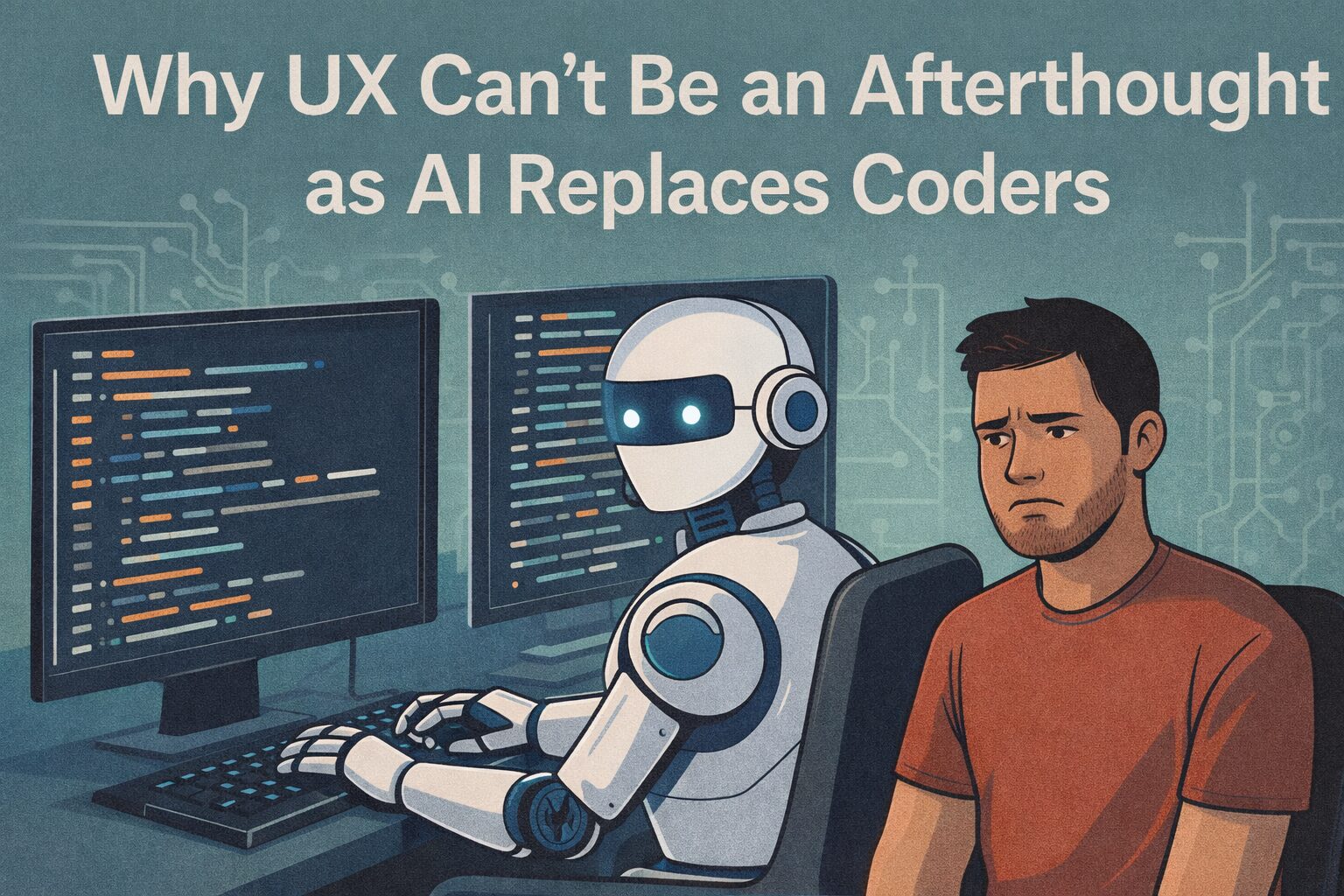
The idea that AI could completely replace coders is no longer speculative. Tools that generate, refactor, and debug code are increasingly framed as substitutes for human developers rather than supports. That framing matters, because when AI replaces coders, it also replaces the informal checks, contextual judgment, and interpretive labor that humans quietly provide.
What gets lost in this shift is not just jobs. It is orientation. When AI replaces coders, someone still has to understand what the system is doing, why it produced a given result, and how that result should be evaluated. That burden does not disappear. It moves.
When AI Replaces Coders, Complexity Does Not Go Away
Much of the discourse around automation focuses on efficiency. Can the system produce working code faster. Can it scale. Can it reduce labor costs. These questions assume that coding is the primary site of complexity.
It is not.
When AI replaces coders, complexity migrates from production to interpretation. Decisions that were once explicit in human-authored code become embedded in probabilistic systems that are harder to inspect and harder to challenge. The result is not simplicity, but opacity.
This is where technical communicators start to see the problem before others do. Systems do not fail only because they are wrong. They fail because users cannot tell when they are wrong.
The Disappearing Human-in-the-Loop
One of the more dangerous assumptions behind the claim that AI replaces coders is that it reduces the need for human expertise. In practice, it changes the kind of expertise required.
Users of AI-generated code must now evaluate output they did not write, debug logic they did not construct, and assess risks they cannot fully see. Interfaces that present AI output as authoritative encourage overtrust. They remove friction at the exact point where judgment should be slowing things down.
Dario Amodei has recently issued a warning that AI capabilities are advancing faster than our ability to understand and govern them responsibly:
We might be 6 to 12 months away from when the model is doing most, maybe all, of what software engineers do end-to-end.
That warning becomes especially urgent once AI replaces coders, because the distance between decision and consequence grows wider.
What Technical Communicators Recognize Immediately
Technical communicators are used to working in environments where systems are powerful, documentation is incomplete, and users are expected to bridge gaps on their own. We know that clarity does not emerge automatically from functionality.
Recent analyses of UX job ads point to a growing demand for professionals who can translate between research, design, and organizational goals. That trend reflects an uncomfortable truth. As systems become more automated, fewer people are accountable for explaining how they work.
When AI replaces coders, explanation does not become optional. It becomes infrastructure.
Why Prompting Is Not Enough
The popularity of prompt engineering reinforces this misunderstanding. Better prompts do not solve the problem created when AI replaces coders. They shift responsibility onto users by asking them to compensate for weak system design.
Prompting is a content strategy issue, not a usability solution. It requires governance, shared standards, and institutional support. Without those structures, prompts become fragile workarounds that break as soon as conditions change.
Treating prompting as a substitute for design mistakes a coping mechanism for a strategy.
When AI Replaces Coders, UX Becomes a Site of Accountability
Human-authored code leaves traces. Decisions can be audited, revised, and explained. AI-generated code obscures intent. It becomes harder to answer basic questions. Why did the system do this? What assumptions were embedded? Who is responsible if something fails?
UX becomes the place where those questions surface. Not because interfaces solve them automatically, but because interfaces determine whether users can even ask them.
If AI replaces coders, then developer-centered assumptions about expertise no longer hold. Systems must be designed for people who inherit decisions rather than make them.
A Role Technical Communication Cannot Avoid
Technical communicators already work where systems meet consequences. As AI replaces coders, that boundary becomes more fragile, not less.
The future will not be defined only by model builders or tool vendors. It will be defined by whether organizations invest in people who understand audience, context, explanation, and ethics. In other words, by whether they take technical communication seriously when AI replaces coders.