
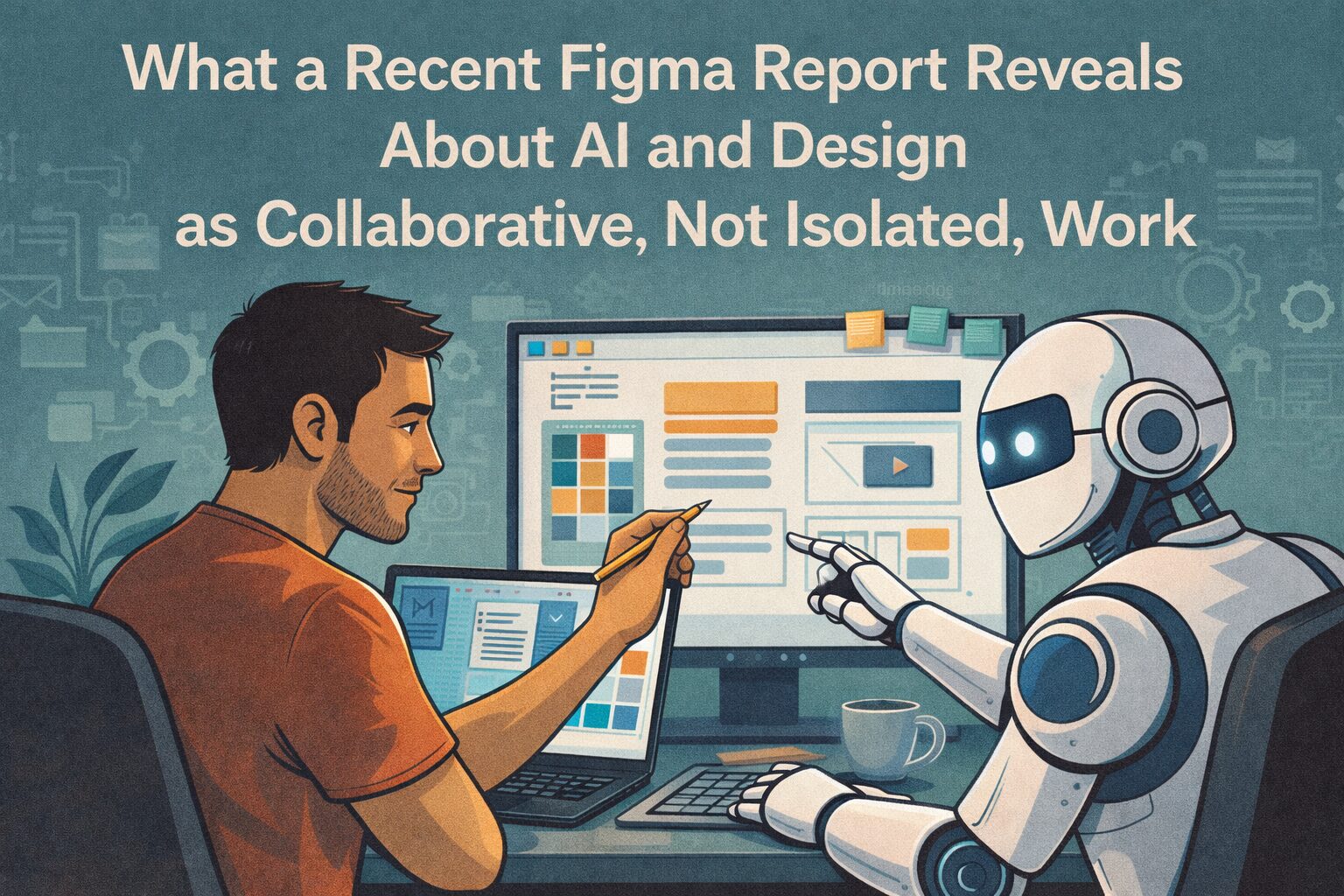
Recent conversations about AI often frame it as a replacement. AI replaces designers. AI replaces writers. AI replaces coders. What gets lost in that framing is the reality of how work actually happens inside organizations. A recent report from Figma on shifting roles in design offers a more grounded picture, one that treats AI and design as fundamentally collaborative rather than isolated activities.
The report is available here:
https://www.figma.com/blog/2025-shifting-roles-report/
For technical communicators, the findings are less about tools and more about coordination, sensemaking, and responsibility.
AI and Design Are Reshaping Roles, Not Eliminating Them
One of the clearest takeaways from the Figma report is that AI is not simply removing tasks from design workflows. Instead, it is redistributing them. Designers are spending less time on rote production and more time on decision-making, critique, and alignment. AI assists with generation, but humans remain responsible for interpretation and direction.
This matters for technical communication because these moments of interpretation are exactly where communication failures tend to occur. When AI generates artifacts quickly, teams still need shared understanding about what those artifacts mean, how they should be evaluated, and who owns the outcome.
AI and design do not function as isolated activities. They operate inside networks of people, tools, and expectations.
Collaboration Becomes the Real Work
The Figma report emphasizes that collaboration is becoming more central, not less. As AI accelerates parts of the design process, coordination across roles becomes more complex. Designers, engineers, product managers, and writers must align on goals, constraints, and tradeoffs more frequently.
This aligns closely with what technical communicators already know. The hardest part of complex work is rarely production. It is negotiation, explanation, and translation. AI and design amplify that challenge by increasing the pace at which decisions are made.
When AI-generated work moves faster than shared understanding, organizations accumulate risk.
What Technical Communicators See That Others Miss
Technical communicators are trained to notice breakdowns in explanation. We see when systems assume knowledge users do not have. We see when documentation lags behind practice. We see when responsibility becomes diffuse.
The Figma report indirectly points to this problem by highlighting role ambiguity. As AI tools blur traditional boundaries, it becomes harder to say who is responsible for what. That ambiguity is not just an organizational issue. It is a communication issue.
AI and design workflows need explicit structures for explanation, traceability, and accountability. Without them, collaboration becomes fragile.
AI and Design Depend on Shared Context
Another key insight from the report is that AI works best when embedded in shared context. Tools that generate design artifacts still depend on humans to define success, evaluate quality, and adapt outputs to real-world constraints.
This reinforces a point technical communication scholars have made for years. Context is not optional. It is infrastructure. AI systems do not remove the need for context. They make its absence more visible.
Design teams that treat AI as a standalone capability often struggle. Teams that treat AI and design as collaborative processes are better positioned to adapt.
Implications for the Field of Technical Communication
For technical communication, the Figma report supports a broader argument. Our field is not peripheral to AI and design. It is central to making them work together.
As roles shift, someone must be responsible for maintaining shared understanding across tools and teams. Someone must document decisions, clarify assumptions, and surface risks. These are not secondary tasks. They are what keep collaboration from collapsing under speed.
AI and design are not isolated activities. Neither is technical communication.