
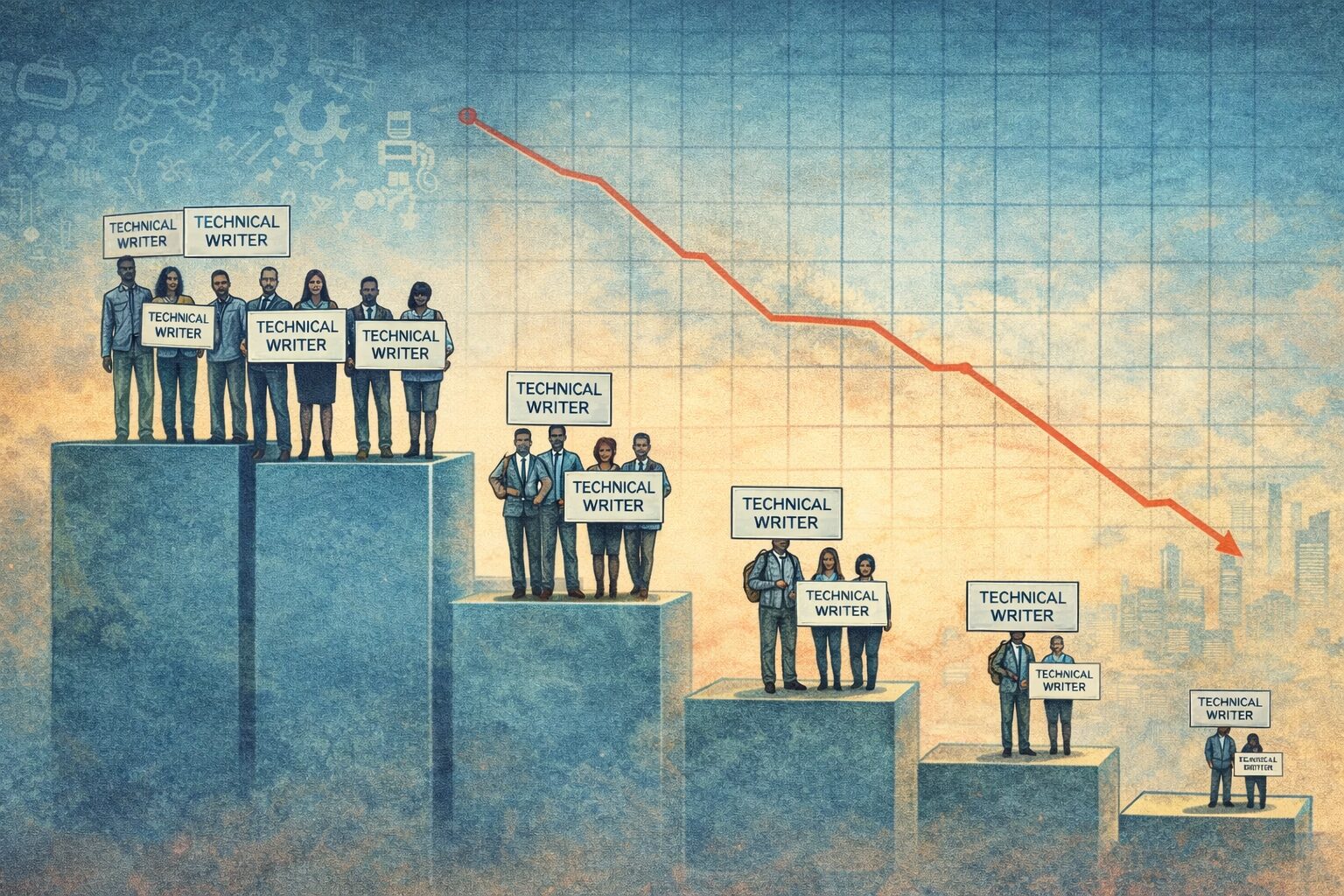
The Bureau of Labor Statistics projects just 1 percent growth in technical writing jobs from 2024 to 2034. That translates into a net gain of about 500 jobs over an entire decade, moving from roughly 56,400 positions to 56,900 nationwide, according to the Occupational Outlook Handbook:
https://www.bls.gov/ooh/media-and-communication/technical-writers.htm
On its face, that number is sobering. For a profession closely tied to technology, software, and digital infrastructure, flat growth raises a serious question. What does the AI impact on technical writing actually look like?
The answer is not simple decline. It is structural change.
The Headline: Flat Growth in a High-Tech Field
According to the Occupational Outlook Handbook, most of the 4,500 annual openings BLS expects will be replacement roles, not expansion:
https://www.bls.gov/ooh/media-and-communication/technical-writers.htm
In other words, the field is projected to sustain itself, not grow.
BLS explicitly notes that artificial intelligence tools may slow employment growth by increasing productivity:
https://www.bls.gov/ooh/media-and-communication/technical-writers.htm
If one writer can produce more output using AI-assisted drafting, structured authoring, automated publishing pipelines, and content reuse systems, organizations do not need to expand headcount at the same rate as documentation demand.
From a modeling standpoint, this makes sense. From a professional standpoint, it signals that the AI impact on technical writing is already embedded in federal labor projections.
Productivity Gains Without Headcount Growth
Practitioner accounts reinforce this story. Writers report significant productivity increases using generative AI to draft, revise, summarize, and restructure content:
https://idratherbewriting.com/blog/ai-is-accelerating-me
Modern documentation toolchains further amplify those gains through automation and reuse.
If output rises while headcount stays flat, the occupation appears stagnant even if documentation volume grows.
This is the core tension in the AI impact on technical writing. The work does not disappear. It changes form and distribution.
Category Drift and the Disappearing “Technical Writer”
Another factor complicates the projection. BLS employment data is tied to specific occupational categories, including Technical Writers under SOC 27-3042:
https://www.bls.gov/oes/current/oes273042.htm
But much of what used to sit squarely under that title is migrating into adjacent roles:
- UX writers and content designers shaping in-product content
- Developer advocates producing tutorials and guides
- Product and support operations teams managing knowledge bases
- Content strategists overseeing structured systems
If documentation expertise spreads across categories, growth may occur outside the technical writer title. The AI impact on technical writing may therefore appear as stagnation in one category while expanding elsewhere.
Embedded Documentation and the Product Experience
Documentation is also increasingly embedded within products themselves. Tooltips, guided onboarding, contextual help, and AI chat interfaces reduce reliance on standalone manuals.
This does not eliminate the need for content expertise. It redistributes it into product teams and design organizations. As a result, hiring may tilt toward roles labeled UX, product content, or experience design rather than traditional documentation departments.
The broader structural approach BLS takes to modeling automation and AI also matters here. The agency explains how it incorporates AI impacts into employment projections in this methodological article:
https://www.bls.gov/opub/mlr/2025/article/incorporating-ai-impacts-in-bls-employment-projections.htm
The modeling reflects gradual structural changes rather than sudden labor shocks. That methodological choice shapes how the AI impact on technical writing appears in official forecasts.
What This Means for Writers
A 1 percent growth projection is not a death sentence for the profession. It is a signal.
The signal is this: technical writing as a narrowly defined job title may not expand significantly over the next decade. But technical communication skills remain deeply relevant.
The strategic response is not withdrawal. It is reskilling.
Writers who understand content systems, UX, analytics, governance, and AI-assisted workflows are well positioned to move into adjacent roles where growth is occurring. Content design, developer advocacy, information architecture, and AI content operations all draw directly on core technical communication competencies.
The AI impact on technical writing suggests that the future belongs to professionals who can operate across systems, not just produce documentation within them.
A Professional Pivot, Not a Retreat
If the labor market is signaling slow growth in traditional technical writer roles, then graduate education and professional development must respond accordingly.
Programs that integrate UX, content strategy, structured authoring, and AI literacy prepare students not only to survive flat growth, but to move into expanding areas of technical content work. The skills that made strong technical writers in the past remain valuable. They simply need to be applied more broadly.
The AI impact on technical writing does not eliminate opportunity. It shifts where opportunity lives.
In a 1 percent growth world, the question is not whether technical communication matters. It is whether professionals are prepared to follow the work as it evolves.