
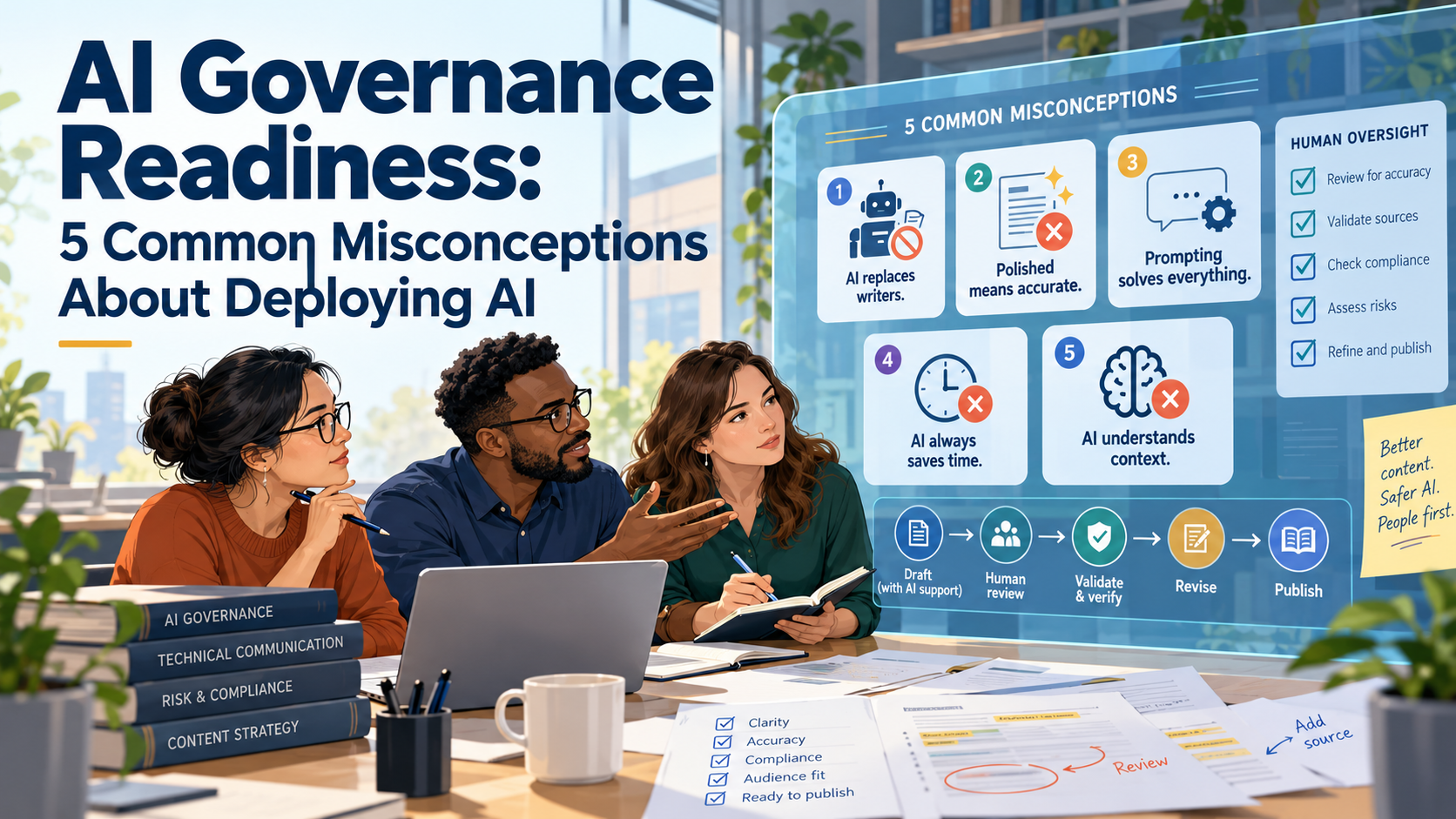
My newest article with Jackie Damrau and Angel Mancio, AI Governance Readiness in Documentation Teams: Survey-Based Insights Toward Governance Readiness, is now available in the proceedings of the 2026 IEEE Professional Communication Conference (ProComm). In the article, Jackie Damrau, Angel Mancio, and I explore findings from a survey of 90 technical communicators to better understand how organizations are integrating generative AI into documentation workflows.
Our findings identify five recurring misconceptions about AI that can help organizations understand their AI governance readiness. These misconceptions reveal important gaps between what organizations expect AI to accomplish and what technical communicators actually experience when using it.
Why Should We Care About AI Governance Readiness?
Organizations are increasingly integrating generative AI into documentation workflows, often with the expectation that these technologies will improve productivity and reduce costs.
However, using AI effectively requires more than adopting new tools.
Organizations also need processes for ensuring that AI-generated content is accurate, appropriate for its intended audience, and consistent with existing documentation standards. We refer to these processes as AI governance.
Our research suggests that many organizations are adopting AI without fully considering how it changes the responsibilities of technical communicators. Rather than simply reducing workloads, AI can shift work toward reviewing, correcting, and validating machine-generated content.
What Are the Five Common AI Misconceptions?
Our survey identified five recurring misconceptions that can interfere with effective AI governance:
- AI can replace technical communicators. Participants reported that managers and clients sometimes assume AI can perform documentation work independently. However, our findings suggest that AI often redistributes work rather than eliminating it.
- AI-generated content is accurate enough to publish. Participants described AI producing polished, professional-looking content that contained factual errors. This creates additional work for technical communicators who must verify its accuracy.
- Better prompting can solve governance problems. While prompting is an important skill, participants reported that even carefully constructed prompts did not eliminate the need for subject-matter expertise, editorial standards, and human review.
- AI automatically improves efficiency. Participants frequently reported that AI accelerated initial drafting while increasing the time required for fact-checking, rewriting, and verification. In some cases, correcting AI-generated content took longer than writing it from scratch.
- AI understands context and audience needs. Participants reported that AI often missed important nuances, emphasized less important information, or failed to account for organizational processes and audience expectations.
These findings suggest that successful AI adoption depends on more than the capabilities of individual AI systems. Organizations also need to consider how these systems fit into their existing communication processes.
How Can Technical Communicators Assess Their AI Governance Readiness?
Based on these findings, we propose three general levels of AI governance readiness.
At lower levels, organizations tend to assume that AI can replace human expertise or produce content that requires little review. Governance is largely reactive, with problems addressed after they occur.
At intermediate levels, organizations introduce some safeguards, such as prompt libraries, style guidelines, or informal review processes. However, technical communicators may still spend considerable time correcting AI output because responsibilities and review procedures remain unclear.
At higher levels, organizations establish clear responsibilities for reviewing, validating, and publishing AI-generated content. AI becomes part of a structured workflow in which human expertise remains essential.
These levels are intended as an exploratory framework for understanding governance readiness, not a validated assessment instrument.
How Can Technical Communicators Improve AI Governance Readiness?
Ultimately, our findings suggest that technical communicators have an important role to play in helping organizations develop effective AI governance practices.
Rather than focusing exclusively on which AI tools to adopt, documentation teams should consider how those tools affect existing workflows.
Who is responsible for verifying AI-generated information? What standards must AI-generated content meet before publication? How much time is actually being saved when verification and revision are considered? How are audience needs and organizational context incorporated into AI-assisted writing?
These are questions technical communicators are well positioned to help organizations answer.
Our study is exploratory, drawing on self-reported experiences from a convenience sample of 90 practitioners. The findings are not intended to represent all documentation teams or establish causal relationships. However, they provide a useful starting point for examining how organizations can move beyond simply adopting AI toward integrating it into sustainable documentation practices.
The goal should not be to automate documentation work at any cost. It should be to develop workflows that make effective use of AI while preserving the human judgment necessary for accurate, usable, and responsible communication.
Get the Full Article
AI Governance Readiness in Documentation Teams: Survey-Based Insights Toward Governance Readiness
Published in the proceedings of the 2026 IEEE Professional Communication Conference (ProComm), pp. 85–92.
Cite the Article (APA)
Getto, G., Damrau, J., & Mancio, A. (2026). AI governance readiness in documentation teams: Survey-based insights toward governance readiness. 2026 IEEE Professional Communication Conference (ProComm), 85–92. https://ieeexplore.ieee.org/document/11728345
Want to Learn More About Technical Communication Management?
Mercer’s fully online M.S. in Technical Communication Management helps working professionals develop advanced skills in content strategy, usability, instructional design, project management, and emerging technologies such as AI.