
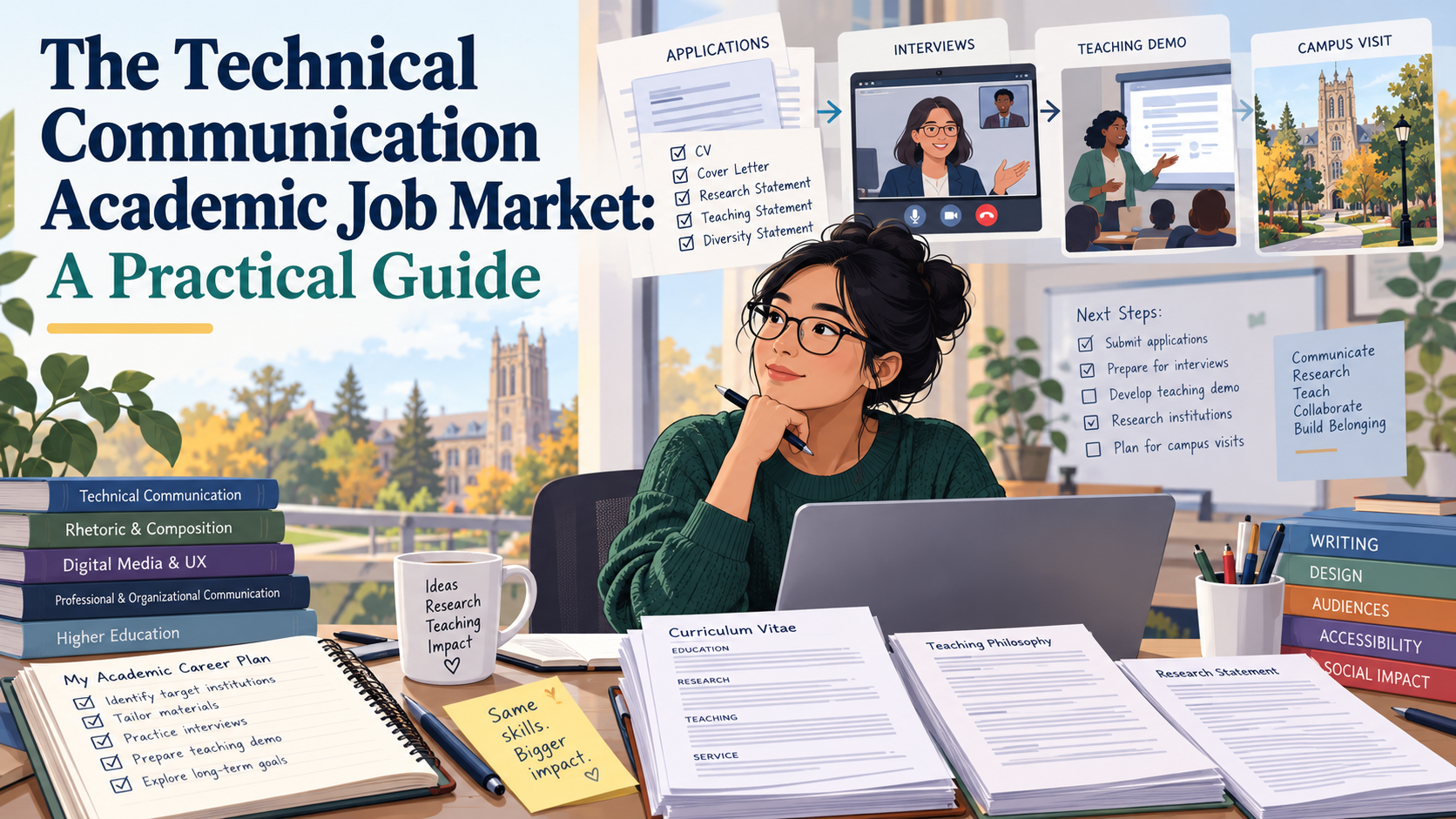
Over the years, I’ve had a lot of people from different walks of life ask me what the academic job market in technical communication is like. Some are graduate students considering academic careers. Others are working professionals interested in teaching or academics considering a move to another institution.
The questions are usually pretty similar. What kinds of jobs are available? What qualifications do you need? What should you put in a cover letter or CV? What happens during a campus interview? And how do you know whether a particular position is actually a good opportunity? These are all good questions, and the answers are not always straightforward. To help people navigate the technical communication academic job market, I’ve put together a free, 15-page guide covering the academic hiring process, from finding positions to evaluating job offers.
Why Is the Technical Communication Academic Job Market Difficult to Navigate?
One of the challenges of pursuing an academic career in technical communication is that positions vary significantly across institutions. Technical communication faculty work in English departments, writing programs, engineering schools, communication departments, design programs, and other interdisciplinary settings. Some institutions prioritize research, while others emphasize teaching, program administration, or professional experience.
Even positions at similar institutions may have very different expectations. For example, the guide compares two faculty searches from 2026. A tenure-track technical and scientific communication position at Virginia Tech emphasized research, publication, and external funding. A clinical assistant professor position in professional writing at Purdue emphasized teaching and the scholarship of teaching and learning. Both positions are relevant to technical communication, but they require very different approaches to the application process. Understanding these differences is essential to developing a competitive application.
What Should You Include in an Academic Job Application?
A successful application needs to demonstrate that your qualifications align with the specific position being advertised. That means more than simply listing your accomplishments.
The guide provides recommendations for developing the major components of an academic application, including:
- Academic cover letters that connect your qualifications to the institution’s needs
- CVs that emphasize relevant research, teaching, and professional experience
- Research statements that demonstrate a coherent scholarly agenda
- Teaching statements that provide evidence of effective instructional practices
- Teaching portfolios and supporting materials that demonstrate your ability to contribute to a program
One of the central recommendations is to tailor your materials to each position. A research-intensive institution may expect applicants to demonstrate a strong publication record and a sustainable research agenda. A teaching-focused institution may place greater emphasis on instructional experience, course development, and evidence of student learning. The same application is unlikely to work equally well for both.
How Should You Prepare for Academic Interviews and Campus Visits?
Getting an interview is an important step, but preparing for one can be challenging, particularly if you have never participated in an academic search before. Academic interviews often involve much more than answering questions about your qualifications. Depending on the institution, you may be asked to give a research presentation, deliver a teaching demonstration, meet with faculty and administrators, talk with students, and participate in several informal conversations. The guide provides examples of common interview questions, recommendations for preparing research presentations, and practical advice for teaching demonstrations.
It also discusses what to do and what to avoid during campus visits. One point I particularly emphasize is that the interview process works both ways. The institution is evaluating whether you would be a good colleague, researcher, and teacher. However, you should also be evaluating whether the institution can provide the resources, working conditions, and professional opportunities you need to succeed. This includes asking questions about teaching loads, research expectations, tenure and promotion requirements, program support, and institutional resources.
What Happens If You Receive an Academic Job Offer?
Receiving an offer is exciting, but it is important to understand exactly what you are being offered before accepting a position. Academic appointments can differ substantially in salary, contract length, teaching responsibilities, research support, promotion opportunities, and job security. The guide provides recommendations for evaluating and negotiating offers, including which terms should be confirmed in writing. The goal is not simply to get an academic position. It is to find a position where you can build a sustainable and rewarding career.
Get the Full Guide to the Technical Communication Academic Job Market
The guide includes 15 sections covering the entire academic hiring process, along with practical checklists, sample interview questions, job-search resources, and examples from actual faculty advertisements. It is designed for doctoral candidates, early-career faculty, working professionals considering academic careers, and anyone interested in learning more about academic employment in technical communication. I hope it provides a useful starting point for people considering careers in the field or preparing for their next academic position.
Download The Academic Job Market in Technical Communication (PDF)
Want to Learn More About Technical Communication Management?
Mercer’s fully online M.S. in Technical Communication Management prepares working professionals to develop advanced skills in content strategy, usability, instructional design, project management, and emerging technologies.