
One of the challenges of talking about AI in technical communication right now is that the conversation is moving faster than our shared frameworks for understanding it.
Over the past few years, generative AI has gone from something many of us were experimenting with at the edges of our teaching and professional practice to something increasingly embedded in the tools, platforms, and workflows that shape writing itself. ChatGPT, Claude, Gemini, Copilot, and similar systems are no longer simply external tools that writers may or may not choose to use. They are becoming part of the infrastructure of professional communication.
This matters for technical communication because our field has always been concerned with how writing gets produced, managed, evaluated, and circulated in real contexts. It matters because AI is changing not only the final products of communication, but also the processes by which those products are created. And it matters because students, teachers, researchers, and practitioners are now being asked to make sense of writing situations in which human communicators and AI systems share rhetorical labor.

That is why Bremen Vance, Geoffrey Sauer, and I are pleased to share a call for proposals for a special issue of IEEE Transactions on Professional Communication:
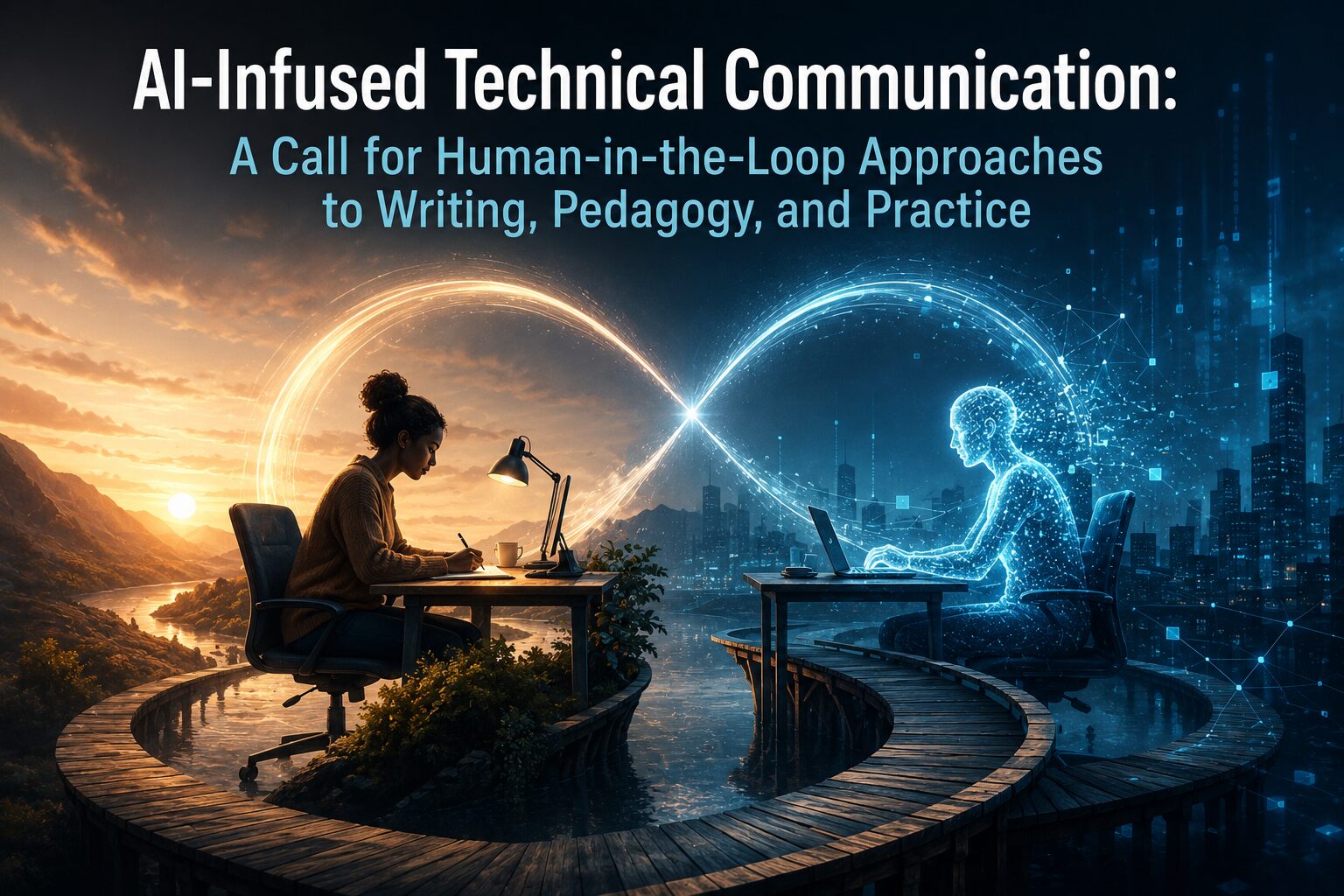
AI-Infused Technical Communication: Human-in-the-Loop Approaches to Writing, Pedagogy, and Practice
A Special Issue for IEEE Transactions on Professional Communication, March 2028
Download a PDF of the CFP Below
Opening of the CFP
The field of technical communication is undergoing a structural shift in how writing is produced, managed, and evaluated due to the introduction of AI. This change is not simply about the emergence of large language models (LLMs) such as those that drive ChatGPT, Claude, Gemini, and Copilot; it represents a fundamental reconfiguration of the writing process. As Stephen Jay Gould’s theory of “punctuated equilibrium” reminds us, long periods of stability can be disrupted by periods of rapid transformation. What is emerging is a complex ecology in which AI handles certain writing and revision functions while human communicators provide oversight, context, and ethical guidance. This human-in-the-loop (HITL) configuration is becoming essential for ensuring quality and accountability in AI-infused workflows. Understanding these shifts is critical for both preparing students to enter AI-rich workplaces and helping professionals adapt their practices to new technological realities.
Why Does This Special Issue Matter?
The premise of this special issue is fairly simple: AI is not just changing tools. It is changing workflows.
That distinction is important. When we treat AI as merely another writing tool, we risk missing the larger reconfiguration taking place around authorship, review, revision, localization, compliance, usability, and pedagogy. AI systems can now generate ideas, draft prose, summarize information, enforce style, transform content, analyze data, and support revision. But the presence of these capabilities does not eliminate the need for technical communicators. It changes where our expertise is needed.
In many cases, human communicators are becoming responsible for designing the conditions under which AI can be used responsibly. That includes crafting prompts, building or evaluating knowledge bases, validating outputs, detecting bias, maintaining compliance, protecting accessibility, and deciding when automation should not be used at all.
This is what makes human-in-the-loop approaches so important.
The “loop” is not just a quality-control checkpoint at the end of a process. It is a way of thinking about where human judgment belongs throughout AI-infused communication work. It asks us to consider when AI should assist, when it should be constrained, when it should be audited, and when human expertise should remain primary.
What Do We Mean by AI-Infused Technical Communication?
In the CFP, we describe AI-infused technical communication as a shift from human-authored communication to human-machine co-authored communication. That does not mean AI and humans contribute equally. Nor does it mean that all AI use is ethical, useful, or desirable.
It means that, in many workplaces and classrooms, AI is increasingly becoming part of the writing situation.
That has consequences for how we teach writing. It has consequences for how we study writing. It has consequences for how organizations define quality, efficiency, accountability, and expertise.
For educators, this shift raises questions about what students need to know in order to enter AI-rich workplaces. Do they need to know how to prompt? Yes, probably. But prompting alone is too narrow. Students also need to know how to evaluate AI outputs, document AI-assisted workflows, understand ethical and legal constraints, and make rhetorical decisions about when automation is appropriate.
For practitioners, the shift raises equally important questions. How do we integrate AI into fast-moving workflows without weakening standards? How do we use automation to support localization, compliance, or documentation without introducing new risks? How do we determine which tasks can be delegated to AI and which require human expertise?
These are not hypothetical issues. They are already shaping technical communication work.
What Scholarship Are We Looking For?
This special issue seeks scholarship that documents, critiques, and advances AI-infused writing practices and human-in-the-loop approaches. We are especially interested in work that moves beyond isolated tool use and toward broader questions of pedagogy, professional practice, workflow design, and programmatic development.
Possible topics include workplace case studies of AI integration, rhetorical load sharing in human-in-the-loop workflows, emerging professional roles and skill sets, compliance and localization practices, programmatic approaches to AI literacy, and the ethical and social justice implications of AI-infused communication.
We are also interested in studies that examine how academic programs are preparing students for AI-infused workplaces. That might include courses, internships, mentoring models, workplace training, credentialing, and other forms of professional preparation.
Some of the questions we hope contributors will address include:
How are students, early-career professionals, and practicing communicators being trained in AI-infused writing and human-in-the-loop practices?
What skill sets are becoming essential for technical communicators working with AI?
What methods and frameworks are being developed in higher education and industry to support AI literacy?
How do technical communicators ensure rigor, accountability, and ethical oversight when integrating AI into rapid prototyping, automated localization, compliance review, or other fast-moving industry contexts?
What case studies illustrate the successes, challenges, or failures of AI integration?
How should changes in AI-infused writing reshape workplace standards and curricula?
How do AI-infused writing practices intersect with inclusive design, accessibility, social justice, and ethical communication?
Why Are Human-in-the-Loop Approaches Central?
The phrase “human-in-the-loop” can sometimes sound overly technical, as though it belongs only to machine learning or system design. But for technical communication, it names something deeply rhetorical.
It asks where human judgment enters a communication process.
It asks who is responsible for the quality of an output.
It asks how decisions get made when AI systems participate in drafting, revising, summarizing, formatting, or validating content.
And it asks how we preserve accountability when authorship becomes distributed across people, tools, datasets, prompts, interfaces, and organizational policies.
That is why this special issue is not only about AI. It is about the future of technical communication as a field that studies and teaches responsible communication in technology-mediated environments.
Types of Projects
We welcome several manuscript genres, including:
Research articles
Integrative literature reviews
Case studies
Tutorials
Teaching cases
For more information about project formats supported by IEEE Transactions on Professional Communication, please consult the journal’s author guidelines:
https://procomm.ieee.org/transactions-of-professional-communication/for-prospective-authors/guidelines-to-follow/
Submission Process
This special issue will use a two-step review process.
First, authors should submit a 500-word abstract in Microsoft Word format summarizing the proposed article. Abstracts should be sent to the guest editors at the email linked in the above CFP.
The guest editors will review abstracts and invite selected authors to submit full manuscripts.
Second, invited full manuscripts will undergo peer review. Based on these reviews, the guest editors will select articles for inclusion in the special issue.
If your project involves human subjects research or uses examples from corporate or government communications, please make sure you obtain all necessary approvals and permissions from your institution, company, or agency before submitting your abstract.
Timeline
Publication of call for proposals: September 1, 2026
Abstract submission deadline: October 15, 2026
Notification of authors: November 15, 2026
Submission of complete drafts: March 15, 2027
Reviews returned to authors: June 1, 2027
Revised drafts submitted for second review: August 1, 2027
Reviews returned to authors: September 15, 2027
Final and complete articles submitted: November 1, 2027
Editing completed by guest editors: December 1, 2027
Correction of proofs: January/February 2028
Special issue published: March 1, 2028
Where We Go from Here
AI is already reshaping technical communication. The question is not whether the field should respond. The question is how.
We need scholarship that can help us move beyond tool demonstrations and broad claims about disruption. We need research that shows what AI-infused writing looks like in actual classrooms, programs, organizations, and workplaces. We need case studies that document what works, what fails, and what remains unresolved. We need theoretical frameworks that help us understand how rhetorical responsibility is being redistributed. And we need pedagogical models that help students develop the judgment required to work ethically and effectively with AI.
That is the work this special issue hopes to support.
If you are studying AI-infused writing, human-in-the-loop workflows, AI literacy, technical communication pedagogy, workplace AI integration, or the changing role of technical communicators in AI-rich environments, we hope you will consider submitting an abstract.
This is a moment of rapid transformation for technical communication. It is also a moment in which our field has a great deal to offer.
We hope this special issue can help create a shared space for that work.