
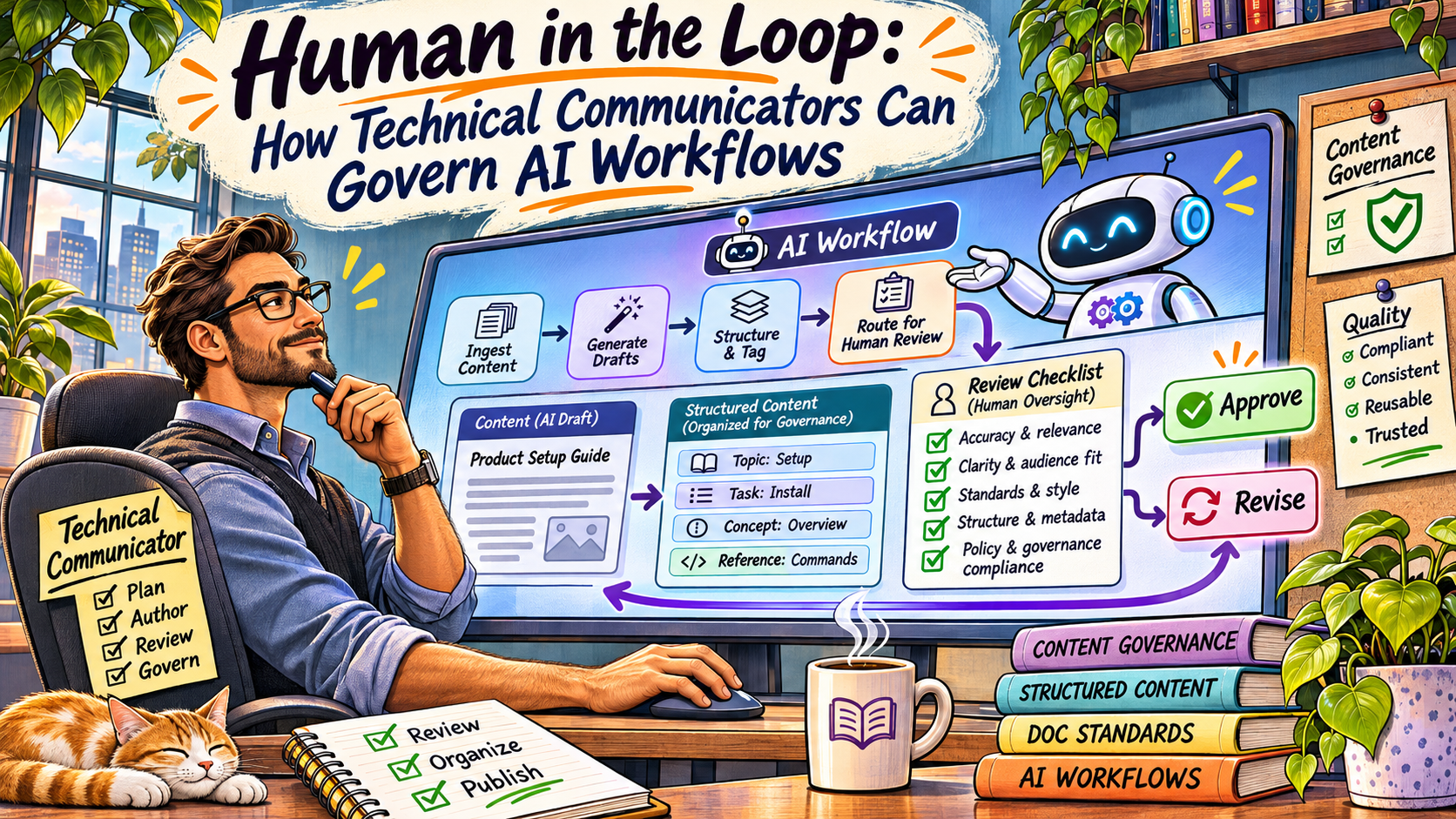
Anyone who has worked in technical communication knows that writing is only one part of the job. Sometimes the biggest challenge is figuring out what to do with the content an organization already has. Consider a common scenario. A subject matter expert hands you a lengthy PDF containing background information, procedures, technical specifications, and other material. Your job is to turn that document into useful, structured content that can be maintained, updated, and reused across different platforms. This can be an incredibly time-consuming process.
Generative AI offers some interesting possibilities for automating this work. However, simply asking a chatbot to rewrite an entire document introduces new problems related to accuracy, organization, consistency, and editorial control. What if we approached the problem differently?
In my newest article with Nathan Gilmour, CTO and Co-Founder of WritemoreAI, we examine a human-in-the-loop approach to AI-assisted content strategy that focuses on automating structural analysis while keeping technical communicators in control of editorial decisions.
Read Human-in-the-Loop Editorial Oversight: A Content Strategy Workflow with WritemoreAI
What Does Human in the Loop Actually Mean?
Human in the loop (HITL) refers to an approach to automation in which human beings remain involved in directing, evaluating, and approving the work performed by automated systems. In technical communication, this means that AI can assist with specific tasks, but human professionals retain responsibility for determining whether the results are accurate, appropriate, and useful.
This approach is not particularly new. Technical communicators have been incorporating automation into their workflows for decades. What makes generative AI different is that it can now analyze, organize, and transform content in ways that previously required substantial human effort. However, these capabilities also introduce risks. AI systems can generate inaccurate information, misunderstand context, change terminology, or reorganize content in ways that alter its meaning.
When organizations treat AI-generated material as finished content, technical communicators may end up spending more time correcting problems than they would have spent producing the material themselves. A human-in-the-loop approach attempts to address this problem by making human oversight part of the workflow rather than something that happens after AI has completed its work.
Why Is Human in the Loop Important for Content Strategy?
One of the central arguments of our article is that the biggest bottleneck in content strategy is not necessarily the speed at which writers produce text. It is often the work required to transform existing information into structured, reusable content.
For example, many organizations maintain large collections of Word documents, PDFs, PowerPoint presentations, and other files that were never designed for reuse. Technical communicators must analyze these materials, identify important information, reorganize content, apply editorial standards, and prepare it for publication. Structured authoring systems, including those based on the Darwin Information Typing Architecture (DITA), can make content easier to manage by separating information into reusable components. However, converting existing documents into these structures is often difficult and time-consuming.
This is where generative AI becomes particularly interesting. Instead of using AI to write more content, we can use it to help organize the content we already have.
How Does WritemoreAI Use Human-in-the-Loop Editorial Oversight?
Our article examines WritemoreAI, a platform designed to transform unstructured documentation into structured, reusable content. Rather than simply generating finished prose, the system uses AI to analyze source material and propose how that material should be organized.
The process begins with content ingestion. Users upload existing material, including Word documents, PDFs, presentations, and other unstructured content. The system then analyzes this material to identify potential topics, relationships, procedures, concepts, and reference information. Based on that analysis, it proposes a structured documentation plan that human editors can review before content is transformed.
Editors can approve, reject, or override the AI’s classifications and review proposed enhancements for accuracy, clarity, terminology, and consistency. Once the material has been reviewed and approved, the system produces structured content, including DITA topics, that can be incorporated into existing content management and publishing workflows.
The important distinction is that human review occurs throughout the process. For example, if the system identifies a section of documentation as a procedural task, a technical communicator can review that classification before it is finalized. The editor might determine that the material would work better as a conceptual explanation or that a lengthy procedure should be divided into several smaller tasks. These are rhetorical and editorial decisions that influence how audiences understand and use information. The system proposes possible solutions, but the human editor determines which ones are appropriate.
How Does This Change the Work of Technical Communicators?
One of the more interesting concepts we discuss in the article is rhetorical load sharing. Essentially, rhetorical load sharing involves distributing communication-related work between people and AI systems.
In a traditional documentation workflow, technical communicators may spend considerable time identifying topic boundaries, reorganizing legacy material, applying structural standards, and correcting inconsistencies. In the workflow we examine, AI performs some of the preliminary analysis and transformation work, allowing technical communicators to concentrate on evaluating the proposed structure and making editorial decisions.
This does not eliminate the need for human expertise. Instead, it changes where that expertise is applied. Rather than spending all their time manually reorganizing documents or correcting AI-generated text, technical communicators can focus on determining how content should be structured, which information is appropriate for reuse, and whether the resulting documentation meets audience and organizational needs.
In other words, AI becomes a tool for supporting content strategy rather than a substitute for it.
Does Human in the Loop Actually Improve Efficiency?
This is an important question, and one that our article does not attempt to answer definitively. Our study is an experience report examining the design and workflow of WritemoreAI. It describes how the system incorporates human editorial oversight and redistributes content-related tasks between people and AI.
It is not an empirical evaluation of the system’s performance. We did not measure productivity improvements, compare the platform against competing tools, or observe documentation teams using it over time. Those questions require additional research.
What the article does demonstrate is how human-in-the-loop principles can be incorporated directly into an AI-assisted content transformation workflow. That distinction matters because organizations should not assume that simply incorporating AI into a process will automatically improve its efficiency. The workflow itself needs to be designed around the tasks people are trying to accomplish.
What Can Technical Communicators Learn from This Approach?
For me, one of the most important implications of this work is that technical communicators need to think beyond using AI as a writing assistant. Many conversations about generative AI still focus on drafting, editing, summarizing, and other tasks involving the production of text. However, technical communication also involves information architecture, content governance, workflow design, and the management of complex information systems. AI can potentially support these activities as well.
The challenge is determining where automation is useful and where human judgment remains necessary. A human-in-the-loop approach provides one way to make those decisions explicit. It also demonstrates why technical communicators should be involved in designing AI-assisted workflows rather than simply adopting whatever tools their organizations provide.
As generative AI becomes more deeply integrated into content management systems and documentation processes, I think this distinction will become increasingly important. The goal should not simply be to produce more content with fewer people. It should be to develop better ways of managing information while preserving the professional expertise necessary to make that information accurate, usable, and meaningful.
Read the Full Article
Our article provides a detailed examination of WritemoreAI’s workflow, including screenshots of its classification, editorial review, and structured content interfaces. It also explores how AI can redistribute rhetorical and editorial labor without removing human responsibility for content quality and governance.
Human-in-the-Loop Editorial Oversight: A Content Strategy Workflow with WritemoreAI
Published in the proceedings of the 2026 IEEE Professional Communication Conference (ProComm), pp. 93–100.
More Research on AI in Technical Communication
This article builds on my ongoing research into how technical communicators can integrate AI into professional workflows. In How to Write With GenAI: A Framework for Using Generative AI to Automate Writing Tasks in Technical Communication, Susan Kelley, Bremen Vance, and I introduce a practical framework for identifying, automating, and evaluating AI-assisted writing tasks.
In AI Governance Readiness in Documentation Teams: Survey-Based Insights Toward Governance Readiness, Jackie Damrau, Angel Mancio, and I examine survey responses from 90 practitioners to identify recurring misconceptions about AI adoption and their implications for documentation governance.
Together, these studies explore how technical communicators can use AI effectively while retaining control over the processes and decisions that shape professional communication.
Cite the Article (APA)
Getto, G., & Gilmour, N. (2026). Human-in-the-loop editorial oversight: A content strategy workflow with WritemoreAI. 2026 IEEE Professional Communication Conference (ProComm), 93–100. https://doi.org/10.1109/ProComm69759.2026.00024
Want to Learn More About Technical Communication Management?
Mercer’s fully online M.S. in Technical Communication Management prepares working professionals to develop advanced skills in content strategy, usability, instructional design, project management, and emerging technologies such as AI.
As AI becomes more integrated into documentation and content operations, these skills are increasingly relevant to professionals interested in leading content teams, managing complex communication workflows, and designing human-centered technology solutions.