
I’ve spent a considerable amount of my career teaching and practicing user experience (UX) research and design. One of the things I’ve learned is that understanding what UX is and knowing how to actually do it are two very different things. It’s relatively easy to explain what a persona, wireframe, or usability test is. It’s another matter entirely to conduct user experience research, translate findings into design decisions, and develop a product that actually meets people’s needs.
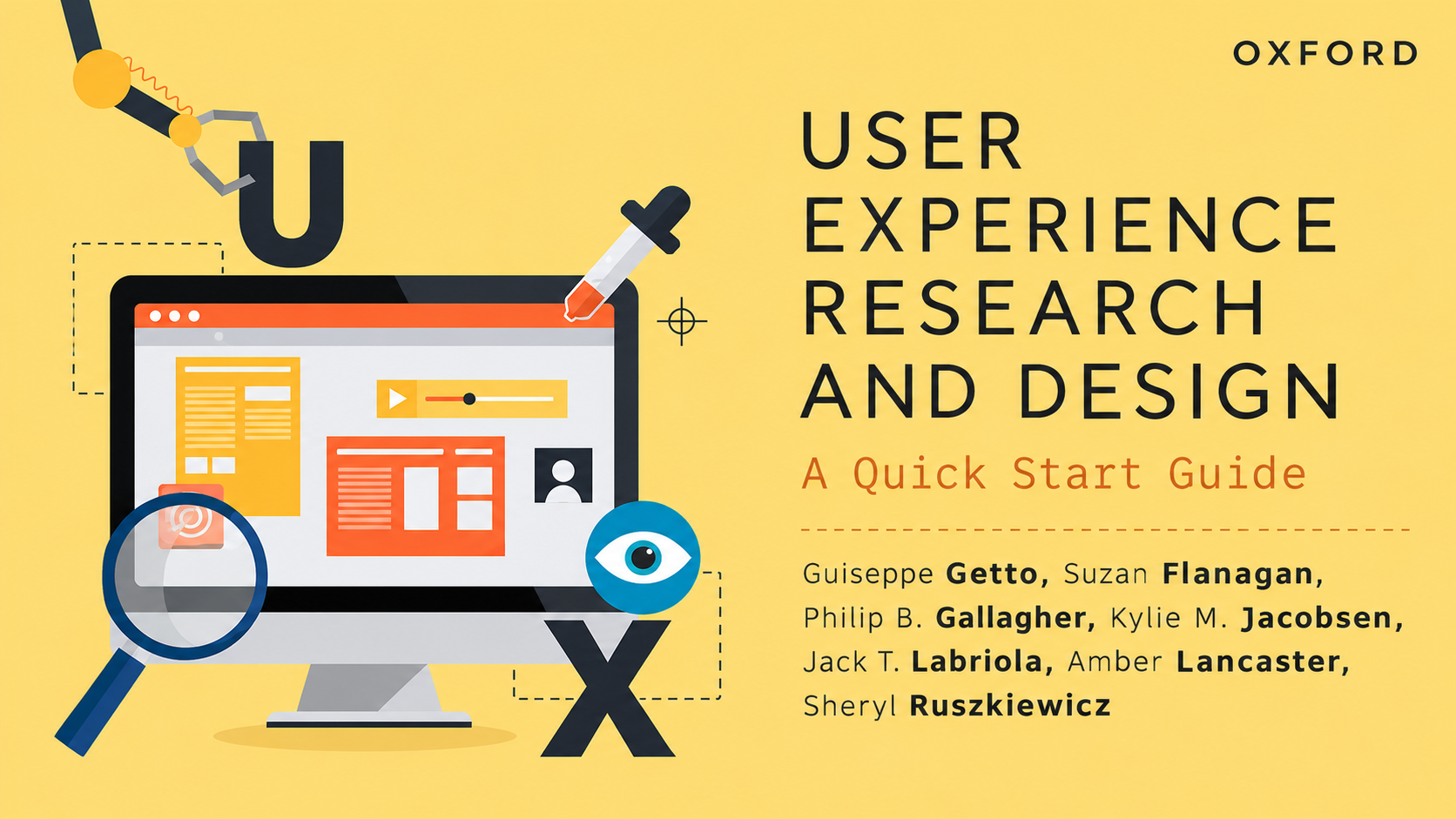
That’s the challenge my coauthors and I set out to address in our new book, User Experience Research and Design: A Quick Start Guide, published by Oxford University Press. Written with Suzan Flanagan, Philip B. Gallagher, Kylie M. Jacobsen, Jack T. Labriola, Amber Lancaster, and Sheryl Ruszkiewicz, the book introduces the essential methods of UX research and design through practical examples, step-by-step instructions, case studies, and hands-on activities. We designed it to serve two purposes: as an accessible textbook for students learning UX and as a practical handbook for professionals who want to incorporate UX methods into their work.
Explore User Experience Research and Design: A Quick Start Guide at Oxford University Press
Why Do We Need Another Book About User Experience Research?
One of the biggest misconceptions about UX is that it’s primarily about designing attractive interfaces. While visual design is certainly part of UX, the field encompasses considerably more than making websites and applications look good. UX is fundamentally about understanding people and designing products that meet their needs. This requires researching users, identifying their goals and frustrations, developing appropriate solutions, and evaluating whether those solutions actually work.
Consider a common scenario. An organization wants to develop a new website. Someone proposes a design, the development team builds it, and everyone assumes the project is successful because the website works. But does it work for the people who actually need to use it? Can they find the information they’re looking for? Can they accomplish their goals without unnecessary frustration? Does the interface meet their accessibility needs? These are questions that cannot be answered simply by looking at a finished product.
Our book approaches UX as a research-driven, iterative process in which design decisions emerge from evidence about users rather than assumptions about what people want. It also recognizes that UX involves a wide range of professional activities, many of which require skills in research, communication, analysis, and collaboration. Understanding how these activities fit together is essential for anyone interested in developing usable digital products.
What Does the Book Cover?
User Experience Research and Design includes 13 chapters covering the full UX process, from conducting initial research to developing and evaluating digital products. We organize the book around five interconnected stages of UX practice: Discover, Define, Ideate, Prototype, and Test. Although these stages provide a useful structure, we emphasize that UX is not a strictly linear process. Designers frequently revisit earlier decisions as they learn more about their users, develop new ideas, and evaluate potential solutions.
The first several chapters focus on understanding users through research. Readers learn how to conduct interviews, surveys, contextual inquiries, and diary studies, as well as how to analyze their findings. We then explain how to translate that research into personas, customer journey maps, and information architectures that help teams make informed design decisions. These are essential activities because they establish what users actually need before developers begin building a product.
The middle chapters focus on translating research into design. We introduce content strategy and UX writing, user flow mapping, wireframing, prototyping, and design systems. Readers learn how to organize information, plan interactions, and create representations of digital products that can be evaluated before development. Later chapters focus on usability testing and accessibility, including methods for identifying usability problems and ensuring that products accommodate users with different needs and abilities.
Finally, we move beyond individual design projects to examine organizational UX strategy and professional development. These chapters introduce topics such as UX maturity, the relationship between UX and organizational goals, and the different careers available in the field. The final chapter also provides guidance on developing a professional portfolio and preparing to enter the UX job market.
Throughout the book, we emphasize how these activities connect. For example, findings from user interviews can inform persona development, which can then guide customer journey mapping, information architecture, and interface design. Rather than treating each method as an isolated activity, we demonstrate how the deliverables produced during one stage of the UX process inform decisions during subsequent stages.
Why Is This Book Suitable as a UX Textbook?
One of our primary goals was to develop a textbook that instructors could use to teach students how to perform UX research and design, not simply memorize terminology. The book’s chapters build progressively on one another, making it suitable for introductory courses in UX, technical communication, information design, interaction design, and related disciplines. Students begin by learning how to understand users and gather research data. They then learn to translate that information into design artifacts, develop prototypes, and evaluate their work through usability testing.
For example, Chapter 2 provides step-by-step instructions for planning and conducting user research, including defining research goals, recruiting participants, developing interview questions, collecting data, and synthesizing findings. Chapter 3 builds on that foundation by explaining how to develop research-based personas. Students learn how to identify behavioral patterns, distinguish evidence-based personas from assumptions, and create profiles that can actually guide design decisions. Later chapters introduce increasingly sophisticated activities, including developing user flows, wireframing interfaces, creating interactive prototypes in Figma, and conducting usability and accessibility evaluations.
One of the features I particularly like is the inclusion of quickstart guides throughout the book. These activities allow students to practice individual UX methods without needing to complete an entire product development project. For example, students can conduct a short user interview, develop a research-based persona, create a customer journey map, build an interactive prototype, or plan a usability test. The activities can serve as classroom exercises, homework assignments, or components of larger course projects.
The book also includes case studies, illustrations, examples of common UX deliverables, and recommended resources that instructors can incorporate into their teaching. This provides a flexible foundation for teaching UX. Instructors can organize a semester-long course around the complete UX process or assign individual chapters in courses focusing on particular research and design methods.
How Can Practitioners Use It as a UX Handbook?
Although the book is designed for classroom use, we also wanted it to be useful to professionals who need practical guidance on performing UX work. This includes UX researchers and designers, technical communicators, content strategists, developers, and other professionals whose work involves designing or evaluating digital products. Many of these professionals already possess expertise in particular aspects of UX but may be less familiar with other methods or how those methods fit into a larger design process.
For example, imagine you’re a technical communicator who has been asked to improve an organization’s documentation website. You understand the content, but you aren’t sure how to determine whether the website’s navigation actually meets user needs. The chapters on user research, information architecture, and usability testing provide methods for investigating that problem, developing potential solutions, and evaluating the results. Similarly, a professional responsible for designing a new application could use the chapters on user flows, wireframing, and prototyping to develop and refine the application’s interface before committing substantial resources to development.
The quickstart guides are particularly useful in these situations because they provide practical instructions for accomplishing specific tasks. Rather than reading the entire book from beginning to end, practitioners can consult individual chapters as needed. Someone planning their first usability test, for instance, can use Chapter 10 to learn how to develop testing tasks, recruit participants, conduct sessions, and analyze the results.
We also include guidance on organizational UX strategy, which can help professionals think beyond individual projects and consider how UX research and design can become part of an organization’s regular workflows. This is particularly important for professionals who are responsible for managing UX activities across multiple products or introducing UX practices into organizations that have limited experience with them. In this sense, the book is intended to be both an introduction to UX and a reference that readers can return to as their responsibilities evolve.
What Makes Our Approach to UX Research and Design Different?
One of the central ideas throughout the book is that UX should begin and end with users. This may sound obvious, but it’s surprisingly easy for organizations to make design decisions based on technological capabilities, business assumptions, or personal preferences rather than actual user needs. Consider how often a project begins with someone deciding which platform or technology to use before anyone has conducted research on the problem being addressed.
Our approach encourages readers to resist that temptation. Before creating interfaces or selecting technologies, we need to understand who our users are, what they’re trying to accomplish, and what barriers prevent them from achieving their goals. From there, we can develop solutions grounded in research and evaluate those solutions through testing. The process is iterative because our understanding of users and their needs will inevitably change as a project develops.
The book also emphasizes the relationship between UX and technical communication. Information architecture, content strategy, UX writing, audience analysis, and usability have always been important components of our field. By integrating these activities into the larger UX process, we demonstrate how technical communication expertise contributes directly to the design of usable digital products. We also emphasize the collaborative nature of UX, which frequently requires researchers, designers, writers, developers, and other specialists to work together.
Ultimately, our goal was to make UX research and design approachable without oversimplifying the work involved. We wanted readers to understand not only what UX professionals do but also how to begin doing that work themselves. Whether someone is encountering UX for the first time or looking for guidance on a particular method, the book provides a practical foundation for developing those skills.
Where Can You Get the Book?
User Experience Research and Design: A Quick Start Guide is published by Oxford University Press and is available through the publisher’s website. The book is suitable for students encountering UX for the first time, instructors teaching UX-related courses, and professionals who want a practical reference for conducting user research and design activities.
View the book and ordering information at Oxford University Press.
Instructors interested in adopting the book for their courses can also request an examination copy from Oxford University Press. The book’s combination of introductory explanations, applied activities, and examples makes it suitable for courses that emphasize hands-on learning and project-based instruction.
Want to Learn More About UX and Technical Communication?
UX research and design are also important components of Mercer’s fully online M.S. in Technical Communication Management. Our program helps working professionals develop advanced skills in UX research, usability, content strategy, information design, project management, and emerging technologies. If you’re interested in developing expertise in these areas or moving into leadership roles involving UX and technical communication, the program provides opportunities to apply research and design methods to real-world communication problems.
Learn more about Mercer’s M.S. in Technical Communication Management.
Cite the Book (APA)
Getto, G., Flanagan, S., Gallagher, P. B., Jacobsen, K. M., Labriola, J. T., Lancaster, A., & Ruszkiewicz, S. (2026). User experience research and design: A quick start guide. Oxford University Press. https://doi.org/10.1093/9780198949497.001.0001
Want to Learn More About Technical Communication Management?
Mercer’s fully online M.S. in Technical Communication Management prepares working professionals to develop advanced skills in content strategy, usability, instructional design, project management, and emerging technologies such as AI.
As AI becomes more integrated into documentation and content operations, these skills are increasingly relevant to professionals interested in leading content teams, managing complex communication workflows, and designing human-centered technology solutions.